All articles Team Genartml · 4 min read
Business
Where AI is real and where it is hype, from someone who builds it
Every week someone asks whether AI can do a job for their business. Here is where it is real, where it is hype, and the three questions we ask before we build anything.
Team Genartml · 4 min read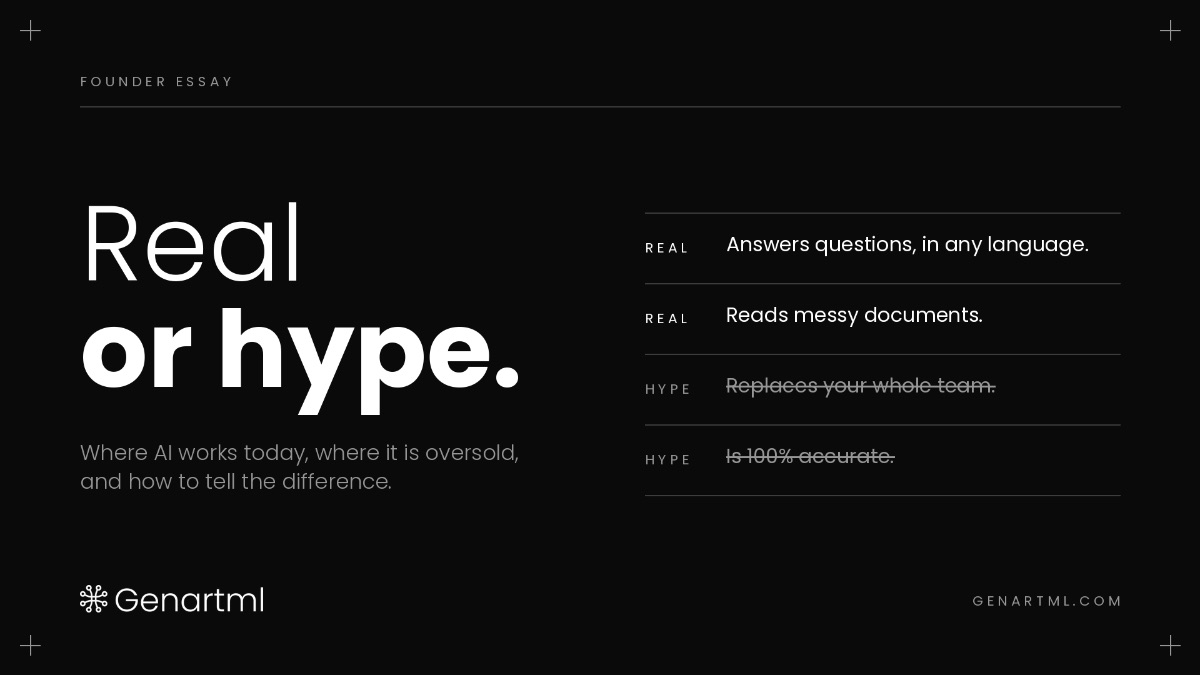
Every week someone asks me a version of the same question: "Can AI do this for my business?"
Sometimes the honest answer is yes, and it will pay for itself in a month. Sometimes it is "yes, but you'll spend more fixing its mistakes than you save". And sometimes it is no, and the person selling it to you knows that.
At Genartml we build AI systems for clients and we run our own AI products, Evoluter for UPSC aspirants and Extuter for JEE and NEET students. So I see both sides: what works in a demo and what keeps working three months after launch. Here is where I draw the line today.
Where AI is real
1. Answering the same questions, all day, in the customer's language.
Most businesses get the same twenty questions again and again. What's the price range, is the slot free, where is the site, what documents do I need. A well-built AI agent answers these on WhatsApp or on a phone call, in English, Hindi or Hinglish, at 11 pm on a Sunday. Our voice agent, Parth, does exactly this. It doesn't need to be clever. It needs to be fast, polite and right.
2. Reading messy documents and pulling out what matters.
Invoices, forms, PDFs, scanned letters. AI is now good at reading a document and filling the right fields in your system. A person still checks the odd one, but they stop typing everything by hand.
3. Connecting tools that never talked to each other.
An enquiry comes in on the website, gets logged in the CRM, the right salesperson gets a summary, and the customer gets a reply. None of that is new. What's new is that AI can read the enquiry and decide where it should go, so the workflow handles real-world messages, not only clean form fields.
4. Helping people learn, one question at a time.
On Extuter, a student stuck on a physics problem gets a step-by-step explanation and a similar question to try next. On Evoluter, a UPSC aspirant gets feedback on an answer they wrote. AI is a patient tutor that is available at midnight before an exam. It doesn't replace a teacher. It fills the hours when there isn't one.
Where it is hype
1. "Replace your whole team with AI."
I haven't seen this work anywhere. AI takes over tasks, not jobs. The businesses that get value from it keep their people and give them the boring half of the day back.
2. Agents that run your business on their own.
An AI agent can do a multi-step task well when the steps are clear and the stakes are small. Give it judgement calls with real money attached, and you need a person in the loop. Anyone who tells you otherwise hasn't watched one fail at 2 am.
3. AI that is 100% accurate.
It isn't, and it won't be soon. Good systems are built around that fact. Our voice agent never quotes a price, because one wrong number on one call costs more than the agent saves in a month. Knowing what AI must not do is half the design work.
4. A chatbot on your website as an AI strategy.
A chatbot that answers "how can I help you?" and then can't help is worse than no chatbot. If it isn't connected to your real data, your calendar or your CRM, it's decoration.
How I decide
Before we build anything, I ask three questions:
- Is this task repeated many times a week?
- Can we write down what a good answer looks like?
- If the AI gets it wrong, is the damage small and easy to catch?
Three yeses and AI is usually the right tool. One no and plain software, or a person, is often better and cheaper. We tell clients that on the first call, even when it means a smaller project.
AI is real. It is also oversold. The way to tell the difference is to ask the person selling it what it can't do. If they don't have an answer, they haven't built it.
Daksh Suthar, founder of Genartml. We build AI workflows, voice AI agents and custom software for businesses across India, on a fixed price and a fixed timeline.