All articles Team Genartml · 10 min read
AI Automation
AI Automation for Businesses: How to Automate Your Business in 2026
AI automation is moving from experimentation to real business operations. Learn how businesses can identify repetitive workflows, deploy AI agents, automate customer communication, reduce operational costs, and build scalable AI-powered systems in 2026.
Team Genartml · 10 min readAI Automation for Businesses: How to Automate Your Business in 2026
AI is no longer just a tool for generating text, images, or answering questions.
In 2026, businesses are using AI to execute real work.
From qualifying leads and handling customer conversations to processing documents, updating CRMs, managing repetitive operations, and supporting internal teams, AI automation is becoming part of how modern companies operate.
The important question is no longer:
“Should my business use AI?”
It is:
“Which parts of my business should AI automate first?”
That distinction matters.
Because adding AI to a business does not automatically create value. The real opportunity comes from identifying repetitive, expensive, slow, or error-prone workflows and redesigning them around automation.
What Is AI Automation?
AI automation is the use of artificial intelligence to perform tasks and workflows that would traditionally require human intervention.
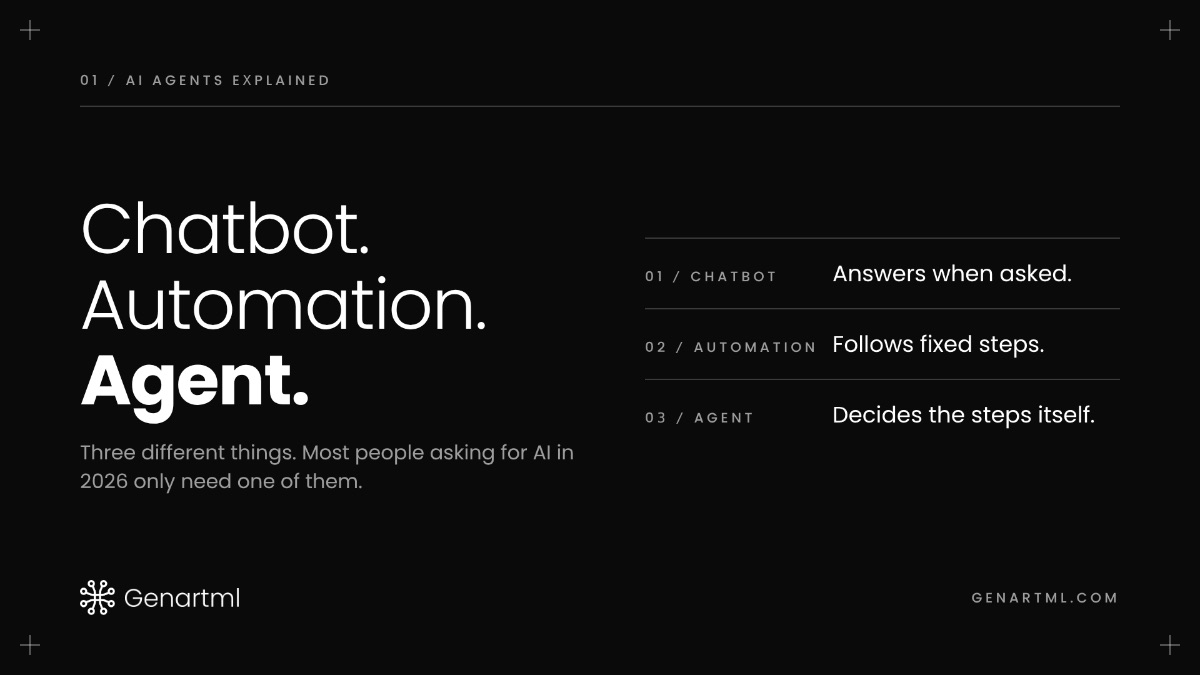
Traditional automation usually follows predefined rules:
If X happens → do Y.
AI automation can handle more complex situations by understanding information, making decisions, generating responses, and taking actions across different systems.
For example:
A traditional workflow might require an employee to:
Receive a customer inquiry. Read the message. Identify what the customer wants. Check the CRM. Respond to the customer. Create a follow-up task. Update the database.
An AI-powered workflow can automate much of this process.
The AI can understand the inquiry, determine the intent, retrieve relevant information, respond appropriately, update the CRM, and trigger the next action.
That is where AI automation becomes significantly more powerful than simple rule-based automation.
Why Businesses Are Moving Toward AI Automation
Businesses are under constant pressure to do more without continuously increasing operational costs.
AI automation can help companies improve three major areas:
1. Efficiency
Employees spend less time on repetitive administrative work and more time on activities that require judgment, creativity, and relationship-building.
2. Speed
Automated systems can operate continuously without waiting for a person to become available.
This is particularly valuable for customer support, lead qualification, sales follow-ups, and other time-sensitive workflows.
3. Scalability
A manually operated process often requires more people as the business grows.
An automated process can potentially handle significantly higher volumes without increasing headcount at the same rate.
This is one reason AI adoption is shifting from isolated experiments toward business-wide implementation. Deloitte's 2026 India research found that Indian enterprises are increasingly deploying AI at scale across functions including product development, operations, marketing and sales, and supply chain.
What Should a Business Automate First?
Not every process should be automated.
The best candidates usually have several of these characteristics:
They happen frequently. They are repetitive. They follow a recognizable workflow. They consume significant employee time. They involve large amounts of information. They create delays when handled manually. They have measurable business outcomes. They do not require constant human judgment.
For example, a company might discover that its sales team spends several hours every day qualifying leads and updating its CRM.
Instead of simply hiring another employee, the company could redesign the workflow around an AI system.
Example
Lead arrives → AI reads lead → AI qualifies lead → CRM updated → personalized response sent → sales representative notified → follow-up scheduled
The employee remains involved where human judgment matters.
AI handles the repetitive operational layer.
That is the real value of automation.
7 Business Processes You Can Automate With AI 1. Customer Support
AI agents can answer common customer questions, retrieve information, classify requests, and escalate complex issues to human employees.
This can create a faster customer experience while reducing the amount of repetitive work handled manually.
2. Lead Qualification
Instead of having sales representatives manually review every incoming lead, an AI system can analyze incoming information, identify high-intent prospects, and prioritize them.
The result is a sales team spending more time on qualified opportunities.
3. Sales Follow-Ups
Many businesses lose potential revenue because leads are not followed up with consistently.
AI can help automate:
Follow-up messages Lead reminders Qualification Meeting scheduling CRM updates Lead routing 4. Internal Operations
Businesses have countless repetitive operational tasks.
Examples include:
Data entry Document processing Report generation Internal requests Information retrieval Workflow notifications Task assignment
These workflows can often be redesigned around AI agents and integrations.
5. Voice-Based Workflows
Voice AI is becoming increasingly useful for businesses that depend on phone conversations.
AI voice agents can assist with:
Appointment scheduling Customer support Lead qualification Outbound calling Reminders Initial customer screening
For businesses receiving large volumes of calls, this can become a significant automation opportunity.
6. Marketing Operations
AI can assist with repetitive marketing workflows such as:
Lead segmentation Content workflows Campaign analysis Customer research Personalization Reporting
The goal isn't to replace marketing teams.
It is to remove repetitive operational work so teams can focus on strategy and creativity.
7. Knowledge Management
Companies often have valuable information spread across documents, emails, databases, websites, and internal systems.
AI-powered knowledge systems can allow employees to ask questions in natural language and retrieve information from approved company sources.
This can dramatically reduce time spent searching for information.
AI Automation vs Traditional Automation
There is an important difference.
Traditional Automation AI Automation Rule-based Context-aware Predictable inputs Can handle unstructured inputs Predefined decisions Can assist with decisions Works best with structured data Can work with text, documents, conversations and more Limited flexibility More adaptable Workflow automation Workflow + intelligence
Traditional automation is still extremely useful.
In fact, the strongest business systems often combine both.
Automation handles predictable execution. AI handles interpretation and decision-making.
What Are AI Agents?
AI agents represent the next step beyond simple AI assistants.
An AI assistant generally responds to a request.
An AI agent can be designed to:
Understand → Decide → Act → Check → Continue
For example, imagine an AI sales agent.
A potential customer submits an inquiry.
The agent can:
Understand the inquiry. Determine the customer's requirements. Check available information. Qualify the opportunity. Update the CRM. Send an appropriate response. Schedule a meeting. Notify the sales team.
The important shift is from AI that answers to AI that executes workflows.
EY's India research shows that businesses are increasingly prioritizing agentic AI across operations, customer service, and marketing, reflecting this movement toward AI systems that can perform more autonomous work.
How Much Can AI Automation Save a Business?
There is no universal number.
Anyone promising that AI automation will automatically “cut costs by 50%” is oversimplifying the problem.
The actual ROI depends on:
Number of employees involved Workflow volume Current process cost Error rates Response times Software costs AI infrastructure Implementation complexity Revenue impact
A better approach is to calculate the economics of a specific workflow.
For example:
Current monthly cost of process
vs.
Cost after automation
Then add the potential value created through:
Faster response times Higher conversion Fewer errors Higher employee productivity Increased capacity Better customer experience
This gives a much more realistic picture of automation ROI.
The broader market is also moving toward this ROI-focused approach. KPMG's 2026 research notes that organizations are shifting attention from simply deploying AI toward accountability, AI economics, and measurable value.
How to Start Automating Your Business
Don't start by buying ten AI tools.
Start with the workflow.
Step 1: Map Your Processes
List the repetitive workflows inside your business.
Ask:
Where are employees spending time doing the same thing repeatedly?
Step 2: Identify Bottlenecks
Find processes that create:
Delays High costs Manual errors Repetitive work Customer frustration Step 3: Calculate the Current Cost
Measure how much time and money the existing workflow consumes.
Without this step, it is difficult to determine whether automation is actually worth implementing.
Step 4: Choose the Right AI Architecture
Depending on the workflow, the solution might involve:
AI agents Large language models RAG systems Voice AI Workflow automation CRM integrations Custom software APIs Human-in-the-loop systems
There is no single AI solution that works for every business.
Step 5: Start With One High-Value Workflow
Don't attempt to automate the entire company at once.
Choose one workflow with clear ROI.
Build it.
Measure it.
Improve it.
Then expand.
Step 6: Measure Results
Track metrics such as:
Time saved Cost saved Response time Conversion rate Error rate Customer satisfaction Revenue generated Employee productivity
Automation should produce measurable business outcomes.
The Biggest Mistake Businesses Make With AI
The biggest mistake is treating AI as a software purchase instead of a business transformation.
Buying an AI tool does not mean your business is automated.
Real automation requires understanding:
People → Processes → Data → Systems → AI → Outcomes
The technology is only one part of the equation.
A poorly designed workflow with AI added to it can still be a poorly designed workflow.
The best implementations redesign the process itself.
AI Automation in India
India is entering a particularly interesting phase of AI adoption.
Indian organizations are increasingly moving beyond experimentation and deploying AI into real business functions.
Deloitte's 2026 India research found that 40% of respondents reported significant or full AI usage, compared with roughly 28% globally.
Meanwhile, EY's research found that 47% of surveyed Indian organizations already had multiple GenAI use cases live, while operations and customer service were among the leading functions being prioritized for GenAI and agentic AI.
This creates a major opportunity for businesses.
The competitive advantage won't simply come from using AI.
It will come from building better systems around it.
Where GenArtML Fits
At Genartml, we believe businesses shouldn't automate simply because AI is popular.
They should automate where AI creates measurable leverage.
We work with businesses to identify opportunities for automation, design AI-powered workflows, build custom AI systems, and integrate them into existing operations.
That can include:
AI agents Voice AI Customer support automation Sales automation Workflow automation Knowledge systems Custom AI applications Business process optimization
The objective is simple:
Find the work that should no longer require humans to do manually — and build the system that handles it.
The Future of Business Is Automated
AI automation isn't about replacing every employee.
It is about changing what employees spend their time doing.
The businesses that benefit most will likely be the ones that treat AI as part of their operating system rather than another tool sitting inside a browser tab.
The question isn't whether AI will change how businesses operate.
It already is.
The question is:
What will your business automate first?